

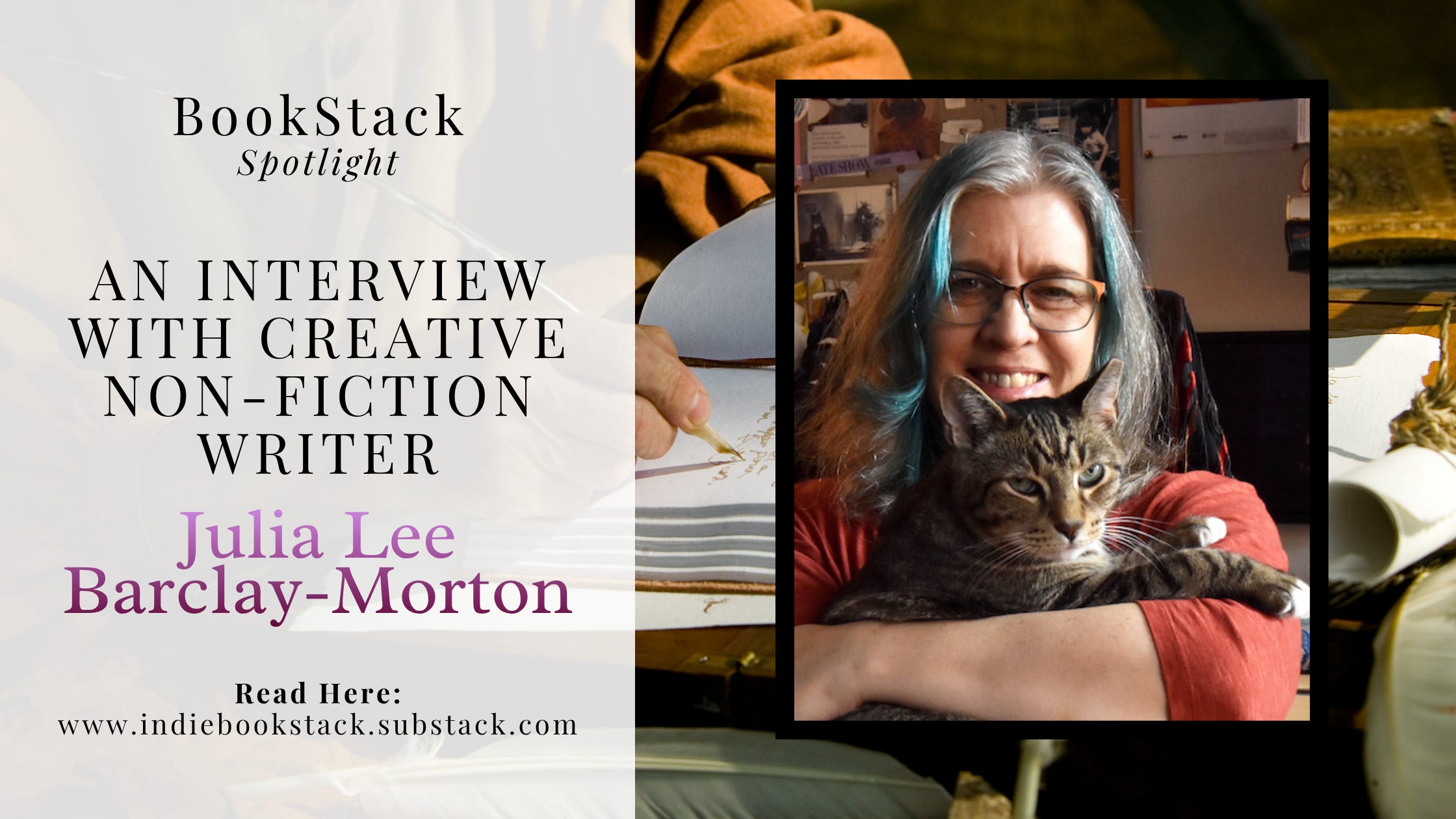
An Interview with Creative Non-Fiction Writer Julia Lee Barclay-Morton
An award-winning writer and director discusses her work and history as a writer in this incredible author spotlight.


Note: Post is too long for email, please read it here. To support us further, consider upgrading your subscription. Thanks <3

Julia Lee Barclay-Morton, PhD is an award-winning writer/director, based in NYC, whose writing has been produced and published internationally; most recently included in Bloomsbury anthology DIVERGENT WRITERS: Disability, Illness, Neurodivergence and Ableism in Creative Writing (2026); hybrid book-length collection THE MORTALITY SHOT published by Liquid Cat Books; recent writing also in Autism in Adulthood, Oldster, Prairie Schooner, [PANK], Heavy Feather Review.
She founded Apocryphal Theatre when in London—which work was the basis of her practice-as-research PhD; 20 years of her stage-texts were streamed, commissioned by Radio Art Zone. Recipient of a Disability Visibility Fellowship funded by Alice Wong to work on a researched memoir about being diagnosed autistic at 57. More at Songs for the Unadapted Ones and TheUnadaptedOnes.com.
If you’d like to support them, you can also find Julia here on Substack. Or you can follow them Bluesky, Facebook, or Instagram. And now, without further ado, onto the interview!

Below are some questions Julia answered for this Spotlight.
What drew you to writing, and what has your journey with the craft been like so far?
I have been writing since I can remember, I'm what's referred to as a hyperlexic autistic, so words have been with me since I was a toddler. The journey however has been rocky at times, because for decades I was writing from an autistic bodymind without knowing it, and while I think my best work came from that place even though I didn't know what it was, I believe now there is an autistic syntax that doesn't necessarily jibe with the neurotypical world. So as a writer you are faced with a question: do I write from who I am, or do I mask here, too?
If you had to pick one, which of your stories was your favorite to write and why?
I don't know how to answer that question. Being autistic, I sincerely believe I will offend one of my pieces of writing by lifting one up. You can laugh (I do!) but it's true! Usually however my favorite thing to be writing is whatever I am writing, even when it's hard (like the 7+ year process of writing my memoir about Very late diagnosed autism, ableism and awe)
And what was the most difficult part of getting your work published for the first time?
I won a writing contest for high school students when I was 14, which shocked me. My English teacher suggested I send in my short story, so I did. I had written it in my voice as an 8 year old writing a diary during Christmas time. Nothing has come as easily since!
Let’s pause for an excerpt from Julia’s book.
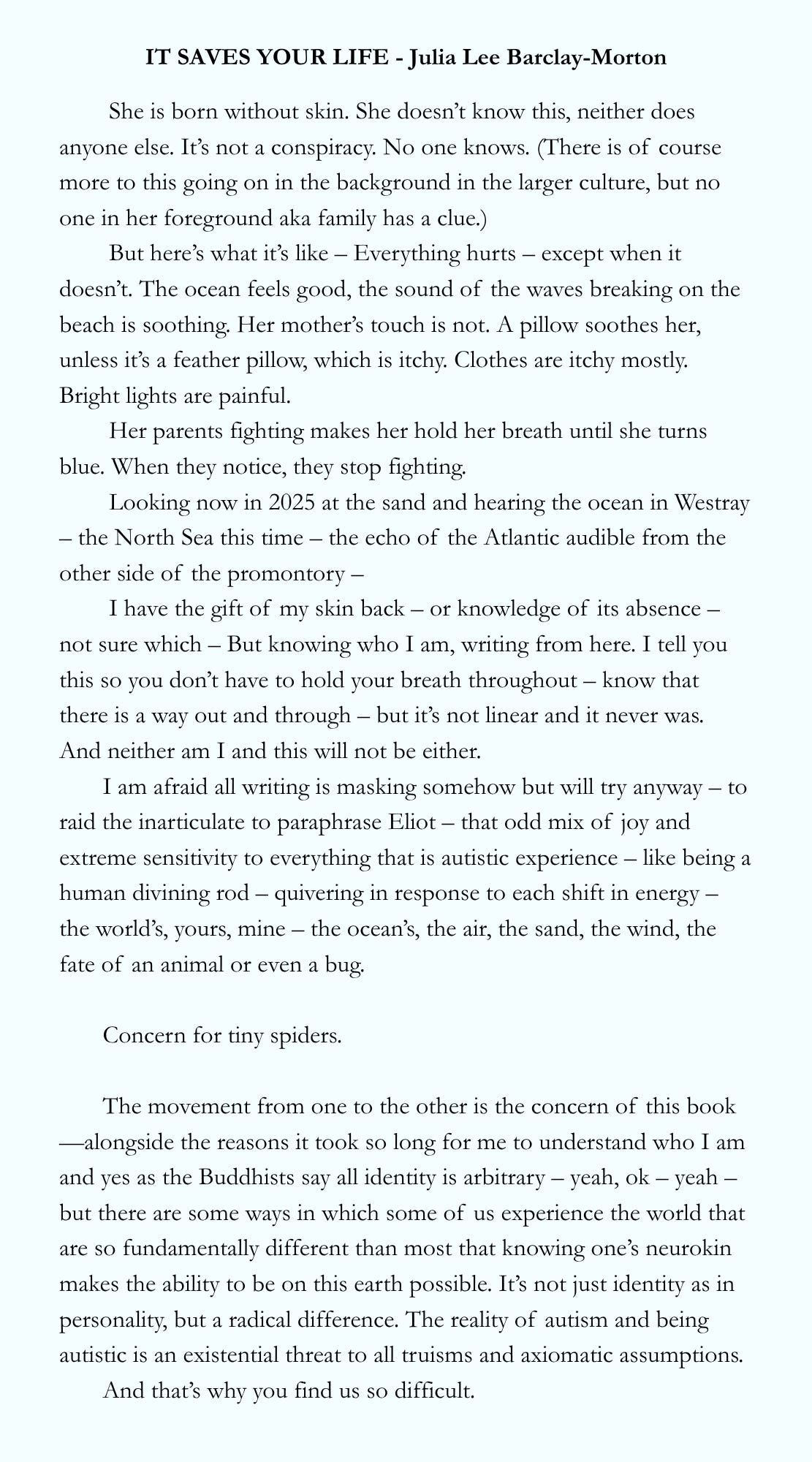
This is an excerpt from an upcoming memoir about very lately diagnosed autism, ableism, and awe. If you’d like updates on it, please subscribe to Julia.
And now… back to the interview.
How would you describe your ideal writing set up?
Basically what I have now: my own study with space to put out all the pieces of what I'm working on and also all my books and enough floor space to do yoga and qigong and a meditation chair. What I wish was different is that this room was in a quieter area (because I live on disability and have never made a lot of money, which is even more challenging now that I also have Long COVID, we live in a rent stabilized apartment in an area of NYC where many people are crowded into apartments, so they spend a lot of time outside playing music and such). I go to a remote island in Scotland I discovered when lived in UK whenever I can to work, which has both the space and the ocean, which is of course the ideal.
What was the most profound piece of advice you’ve ever received? How did it influence your writing?
It was an exercise in a writing class led by Patty Dann, who is a wonderful writer and teacher. She asked us to write about learning to drive. She gave us like 10-15 minutes max. When we were done, she said, there...what you wrote there, that's your voice. And damn if she wasn't right! My writing got a lot better after that. That first short story I wrote at 14 had followed that advice by accident, and it took me until I was 29 to re-learn it.
And do you have any book or story recommendations?
I have SO many. My best list is on my Substack as the essay "...these thousands of little witnesses...", so instead of trying to replicate that list, I'm going to offer you the link.

Lastly, is there anything else you’d like readers to know about you and your work?
My primary goal now as a writer is to embody the unmasked autistic experience so that my neurokin and I can see our lives as we live them in a form that isn’t masked for neurotypical convenience. However, I also hope that allistics (non-autistics) will also read my work to understand people in their lives who are autistic, and perhaps to see how one can find joy in late life discoveries that radically reframe your life.
That is perhaps the more universal story in the specific one, because getting older is a series of adjustments if nothing else. My book also includes dealing with Long COVID alongside the autism discovery journey, so it’s about understanding disability outside of the cliches and learning to embrace a new form of life and pace and time without pathologizing it. Unearthing ableism has been the most profound gift of this time of my life, and I hope my writing can aid that. Both in its form and content.

Synopsis for each book or series is pulled directly from their webpage.
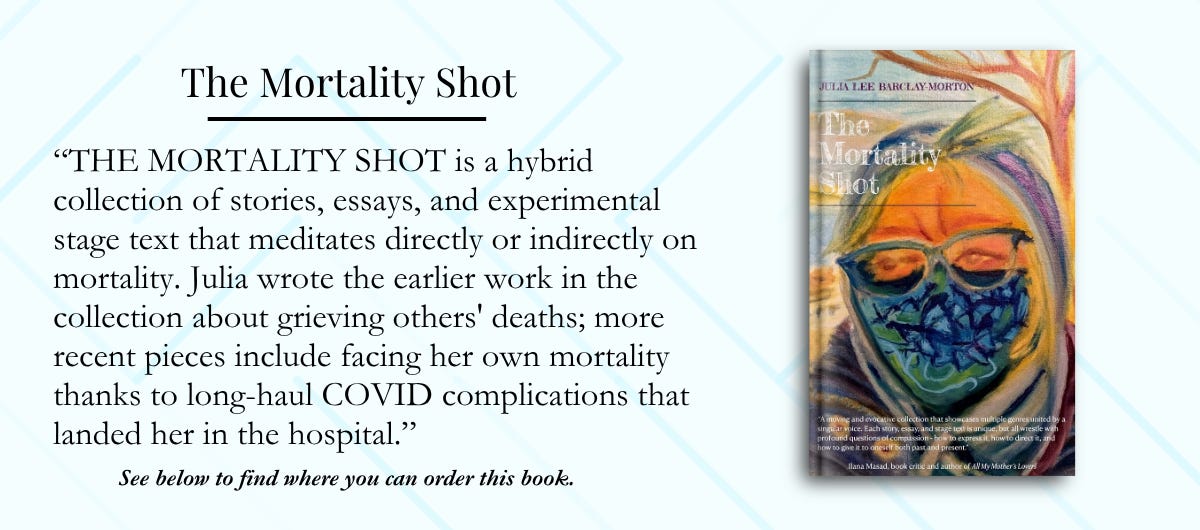
THE MORTALITY SHOT is a hybrid collection of stories, essays, and experimental stage text that meditates directly or indirectly on mortality. Julia wrote the earlier work in the collection about grieving others’ deaths; more recent pieces include facing her own mortality thanks to long-haul COVID complications that landed her in the hospital.
“These stories and essays (plus a stage text) push up against heartfelt questions of life and death in ways that are complex, counter-intuitive, humorous and striking. Writing against the grain, in varying styles and intensities, The Mortality Shot goes places that so much current literature wouldn’t dare, demonstrating that real writing is always a risk and a gamble, and that only through taking such risks can we get at the things which truly matter.”
~ Jacob Wren, author of Polyamorous Love Song
Bringing together essays from neurodivergent and disabled writers, and writers with chronic illnesses, this collection explores the impact of these experiences and the struggle against such biases within the field of creative writing. Whilst neuro-divergent and disabled writers publish world-class poetry, prose, and drama that moves readers and wins awards, they face many difficulties accessing these achievements - difficulties which often go unnoticed, unmentioned, and underappreciated. Visibility, insight, alternative approaches, and thorough research are all needed to create more inclusive writing environments. This book confronts these issues head on, calling for diversity in the creative writing field, community, and industry, and more equitable spaces in adjacent arenas from academia to publishing.
Broken into four sections, this anthology focuses on creative writing programs, classrooms, the community, and its people, combining narrative, research and practical contributions to the field to offer a mix of practical strategies, personal and pedagogical interventions, critiques, and craft meditations that explore teaching, transformation, evolution, embodied craft, visibility, belonging, injustice, otherness, and views from the outside. With essays and excerpts written by authors and educators from across seven countries, who are each impacted by a wide range of disabilities, including ADHD, autism, blindness, dyslexia, dyspraxia, stroke aphasia, cerebral palsy, bipolar, fibromyalgia, and rheumatoid arthritis, this collection informs, deconstructs and re-imagines to reform and revolutionize normative structures within writing institutions and communities.
Other Published Works:
Essay included in Divergent Writers Bloomsbury Anthology: “Bringing together essays from neurodivergent and disabled writers, and writers with chronic illnesses, this collection explores the impact of these experiences and the struggle against such biases within the field of creative writing.” Order here.
Published in the Plays and Playwrights 2001 anthology: “Anthology of new works from the New York theatre, all of which premiered during 2000.” Order here.
Well, we’re just about to wrap things up! First though, Julia has some things to share about their upcoming memoir. Let’s hear it:
“I have completed a first draft after 7 years of a research/hybrid memoir about very-late diagnosed autism, ableism and awe. It's now out with beta readers and once I compile feedback, I will do another pass of revisions before querying it with agents and publishers.”
Exciting news for sure! If you’d like to stay updated on her upcoming work, make sure to give her website or Substack a visit. Or, you can follow her on social media (Bluesky, Facebook, or Instagram) as well!
Thanks so much for letting me highlight you and your work Julia! And to everyone else for reading all the way through! I’ll see you all in the next one. Buh-bye for now!
 | A guest post by
|