

Short Story: Song Beneath the Waves by Ms. Kaye
Our first featured short story turns tides when a couple's reuniting goes terribly wrong.


Hello everyone, and welcome to our first featured short story here on BookStack. Akin to what we used to do with the Poe-Tato Writing Collective, I’ll be following a similar post structure: An introduction, the featured piece, insights from the author, and lastly my own thoughts.
Before we dive into the story feature, you can stayed updated on all things Kaye Terrelonge by subscribing to her Substack— and over on her website you can check out all of her art, products, and more.
You can also support Kaye by checking out her collection of two-sentence horror stories, which is available on Amazon.
Lastly, Kaye’s feature, which is titled Song Beneath the Waves, was originally written in 2013. Initially named Sounds of the Ocean, it was published and released on Amazon in Paperback and eBook formats. And has since been re-written, which is what we’re showcasing today. Let’s dive in!

Song Beneath the Waves
A storm steals Henry for nearly an hour beneath the waves. He returns home alive, but not unchanged. As the moon waxes and the tides grow fierce, Mary realizes the ocean is not finished with her husband — it is only claiming what belongs to it.
One
Henry had not spoken since the rescue.
He sat on the patio facing the horizon, swaddled in layers of terrycloth as though winter gripped the coast, though July sunlight burned against the glass. His sunglasses hid the eyes that had once been so quick to crinkle at her smile. Now they reflected only the sea.
Mary could not stand the silence. She invited a neighbor she barely knew for coffee, anything to soften the ache of being the only one left alive in a house not yet emptied of its second soul. Henry didn’t turn his head when the old woman entered, didn’t blink as they sat with steaming cups behind him.
“How long has he been like that?” the neighbor asked, lipstick smearing the rim of porcelain. Mary clutched her mug as though it might steady her. “Since the accident. The storm capsized us. They found me quickly, but Henry…” She hesitated, throat closing. “He was gone for almost an hour before the Coast Guard pulled him out. I thought he was—”
Her guest’s eyes lingered on the stiff figure outside. “Perhaps he was.”
Mary flinched. The coffee had gone cold in her hand, but she drank anyway, salt stinging her tongue.
Two
The sea came home with Henry.
Salt damp spread across the patio tiles no matter how often she scrubbed. The air inside the house carried the stink of rotting kelp. By the second week, mold bloomed across Henry’s robe in patches the color of bruises.
On the quarter moon, she flicked on the floodlight and nearly collapsed. His robe had slipped open. His legs were sheathed in pale, iridescent scales, slick as if freshly skinned. Between his fingers, skin stretched into translucent webbing that quivered when he moved.
Mary bolted, locking herself in the bedroom. But the vision clung, and worse followed. By the half moon, she heard it: a sound beneath the tide. Not wind, not waves — a long, low weeping that seemed to rise from the abyss. Whenever it carried through the glass, Henry’s head tilted, body tensing as though straining toward a voice only he could answer.
She began watching from doorways. His skin grew tighter, drawn to bone. His eyes darkened, round and glossy, swallowing color. At night she swore she saw him glisten, as though seawater seeped from his pores. The ocean outside had grown louder too — tides slamming harder, the rhythm of the surf not random but deliberate, a heartbeat pounding against the shore.
On the night of the gibbous moon, she glimpsed his face bare in the moonlight. The nose collapsed to slits. The lips stretched thin, almost pointed. His chest swelled strangely, ribs fluttering with each breath. She pressed her fist to her mouth to smother a sob.
Her husband was being remade.
Three
The full moon dragged the storm ashore.
Winds shrieked, tearing shutters from hinges. Waves hurled debris against the walls until the whole house rattled in its frame. Mary nailed boards across the windows, her hammer slipping from damp hands. But when she turned to secure the glass doors, she froze.
Henry was standing.
The robe fell in tatters at his feet. His body glistened, entirely sheathed in scales. Along his spine, a row of fins shivered open like knives catching the moon. Gills split his ribs with wet, sucking gasps. His arms hung loose, fingers dripping with mucous, palms twitching as if eager to grasp the sea.
And then she heard it. The song.
It was no longer a distant weeping. It was melody — a keening wail that clawed at the bones of the house, shaking dust from rafters, pressing against Mary’s skull until her vision blurred. Henry lifted his face toward it.
Out of the storm surge, she emerged.
At first, only a silhouette — tall, rising upright against the crashing surf. But lightning split the sky, and Mary saw her clearly. A strange figure, what resembled a woman, yes, but stretched monstrously long, hair writhing like streaming weeds, eyes gleaming black as midnight tide. From her waist down, there were no legs: only coils armored in dark scales, rippling with obscene grace, ending in a spined tail that churned the water white.
The siren spread her arms. Her mouth opened, revealing rows of thin, sharp teeth. The song was hers.
“No!” Mary screamed, lunging forward. She seized Henry’s arm — slick, cold, coated with a gelatinous slime that burned her skin. She gagged, trying to hold on, but his new strength tore him from her grasp as though she were no more than sea foam.
Henry vaulted the railing. His limbs jerked oddly, neither man’s nor beast’s, as he stumbled toward the waves. The siren’s coils lifted, ready to receive him.
“Henry!” Mary shrieked into the gale. “Come back!”
He didn’t turn. He fell into her embrace, scales sliding against scales, their bodies twining like reunited lovers. His face tilted up to hers, lips brushing her scaled cheek with a reverence Mary had never seen in him.
With one final heave of her tail, the serpent dragged him under.
The storm broke. The winds died. Silence rolled in with the tide.
Mary pressed her forehead against the glass, breath clouding the pane. She searched the dark surf, desperate for anything human.
And then she saw them.
Beneath the waves, faint but clear; Henry’s pale face against hers, lips moving, singing back. The she-creature’s coils wound around him possessively. Her eyes flicked up, straight to the shore. Mary staggered back, heart pounding. The gaze pinned her where she stood.
Then the sea surged high, a wave towering over them. In its rise she glimpsed the two entwined — a loving, yet sickly embrace — before the waters crashed down, pulling them into the black.
Moments passed. Mary remained rooted, uncertain if she had witnessed truth or madness, waiting for something more.
The storm had left the house hollow. Boards hung broken, saltwater seeped beneath the doors, and every surface reeked of brine. She pressed her palm to the glass where Henry had vanished, whispering his name into the silence.
No answer came, only the hush of waves. Yet in the pause between breakers she swore she heard it — his voice, woven into the siren’s song, tender and terrible at once. And when she lifted her gaze, the dark water was still watching her back.

Below are some insights from Kaye.
Can you tell us about the inspirations behind your story?
When experiencing a bad situation, rather than going to prison for the deed, why not create a scene with words rather than action?
Of course, this was before THE SHAPE OF WATER (great film), but did get inspiration from SHE-CREATURE (not the Dennis Hopper, but the 2001 version) ... because mermaids were not so friendly, more like hungry.. LOL.
Is there anything you hope readers will take away from it?
The takeaway from the story isn’t so much about the plot itself, but the energy behind it. Rather than letting frustration take over, I’ve learned to channel it into creation—whatever form it takes. That’s what I’ve learned from other authors: to take what surrounds us—grief, absurdity, joy—and shape it into something that speaks. If the story resonates, it’s because someone else has stood in that same emotional hallway.
And any additional insights or info for readers?
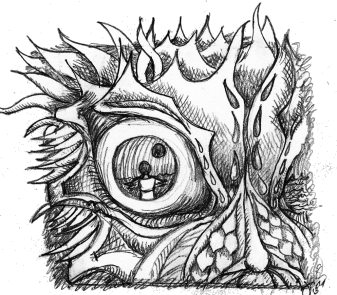
The image created was done my aunt who was an artist at the time, the style I sought for my short stories were paying homage to the 1940s horror pulp magazines. Raw, yet haunting.


First, I love the structure of this story— splitting it into three parts with increasing waves of tension. It’s intricate and haunting, yet compelling and emotionally bound.
The nature of uncertainty in dealing with potential loss, only to discover the one you loved is no longer themself. It would feel incredibly depressing if not for the horrifying transformation unfolding before your eyes.
Second, I love Kaye’s use of imagery and language— weaving the ocean into each aspect of the story. As things ramp up, it’s more akin to watching the tide increase in size… Just as a storm rolls in the distance.
This was a beautifully crafted read, and the energy you put into the story beats feels so contagious. Thank you Ms. Kaye for sharing this fantastic read, and for allowing us to feature it on BookStack. I hope everyone else enjoys the story as much as I did (I think my friend
will for sure).But our dear readers, what did you think of that story? Let us know in the comments.
And if you have a story, news, and book oriented discussions you want featured, just fill out our submission form.
 | A guest post by
|
This is beautiful. I love the omnious vibe and the growing tension Kaye created in this piece. 🌊🌑
You were correct in your prediction that I would love this, Hazel! As a fan of Del Toro, The Shape of Water, and of course, Lovecraftian Horror, this story was checking all my boxes as I read it!
It reads almost like a fable or a cautionary tale that has been passed down from one generation to the next. It's a piece that is simultaneously timeless and painfully relevant, much like the sea itself.
Beautiful, heart-wrenching, and more than a little terrifying to behold. I loved this!